
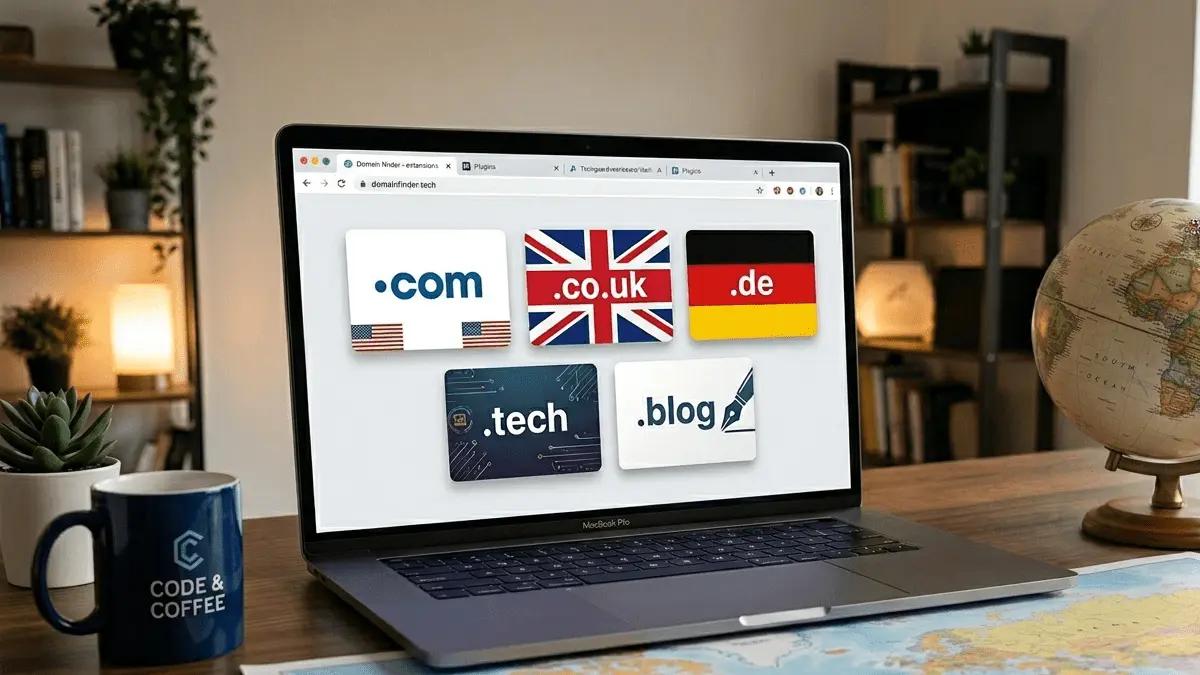
When you start building a website, one of the first decisions you face is choosing a domain name. But beyond the name itself, the extension—the part after the dot—carries significant weight. Should you go with a classic .com, a country‑specific .uk, or a generic .tech? And does your choice actually affect how search engines and users perceive your site’s target audience?
This guide unpacks the differences between TLDs (Top‑Level Domains) and ccTLDs (country‑code Top‑Level Domains), how they impact SEO, user trust, and international targeting, and how to choose the right one for your business—whether you’re targeting a local city or a global market.
Table of Contents
What Are TLDs and ccTLDs?
A TLD (Top‑Level Domain) is the last segment of a domain name. There are two main categories:
- gTLD (Generic Top‑Level Domain) – These are not tied to a specific country. Examples:
.com,.org,.net,.tech,.blog,.store,.online. - ccTLD (Country‑Code Top‑Level Domain) – These are two‑letter extensions assigned to countries or territories. Examples:
.us(United States),.uk(United Kingdom),.de(Germany),.in(India),.jp(Japan).
The distinction matters because ccTLDs carry inherent geographical meaning—both for users and for search engines. A .de domain signals “Germany” to a visitor even before they read the content.
A Special Case: gccTLDs (Generic Country Code TLDs)
Some ccTLDs have become so globally popular that Google treats them as generic rather than country‑specific. Examples include:
.co(originally Colombia) – now used globally for companies.io(British Indian Ocean Territory) – heavily used by tech startups.tv(Tuvalu) – popular for video/content sites.me(Montenegro) – personal branding.ly(Libya) – often used for URL shorteners
For these, Google ignores the “country” signal and treats them exactly like a .com. If you’re a startup founder choosing .io for its “input/output” tech connotation, rest assured it won’t be geo‑locked to a remote island.
How Search Engines Treat TLDs vs. ccTLDs
Search engines like Google use a variety of signals to determine where to rank a website. The domain extension is one of them.
- ccTLDs are strong geo‑targeting signals. Google assumes that a
.frdomain is intended for a French audience. You don’t need to set up geolocation in Google Search Console—the domain itself tells Google your target country. - gTLDs are geo‑neutral. A
.comdomain could target anywhere. Google relies on other signals like the server location, language, backlinks, and content to infer the target audience. You can optionally set a target country in Google Search Console, though in recent years Google has automated much of this and now places more weight on hreflang tags and content signals.
Important: New gTLDs (like
.tech,.shop,.blog) are treated the same as traditional gTLDs—they do not provide inherent geographic signals.
User Perception and Trust
The domain extension influences how users perceive your business before they even click.
- ccTLDs build local trust. A visitor from the UK is more likely to click on a
.co.ukdomain when searching for a local plumber or solicitor because it signals a UK‑based business. - gTLDs feel global. If your business operates internationally, a
.comoften feels more neutral and can be easier to remember for a global audience. - Privacy and legal trust: In 2026, users are hyper‑aware of data privacy regulations like GDPR (EU) and CCPA (California). A ccTLD like
.euor.designals to visitors that your business is bound by local consumer protection laws—a significant conversion booster for e‑commerce and services. - New gTLDs can convey purpose. A
.photographydomain can immediately tell visitors what you do, but some users may still be more accustomed to traditional extensions.
Geo‑Targeting: The Practical Difference
The core question—“Does it really make a difference?”—is best answered with examples.
| Scenario | Recommended Domain | Why |
|---|---|---|
| A local restaurant in Berlin | .de | Google will naturally rank it higher for German searches; locals will trust the .de immediately. |
| A global SaaS company | .com | Neutral, professional, works in every market. You can then use subdirectories or subdomains for localized versions (e.g., /de/ or de.example.com). |
| A UK‑only e‑commerce store | .co.uk | Strong UK signal; customers expect a UK site for faster shipping and local support. |
| A portfolio for a freelance photographer | .photography or .com | Creative gTLD can help you stand out, but .com is still the safe default. |
| A startup with limited budget targeting multiple countries | .com | Cheaper and easier to manage than buying multiple ccTLDs and maintaining separate sites. |
| A tech startup wanting a global “tech‑savvy” vibe | .io (gccTLD) | .io is treated as generic, so it won’t be geo‑locked, but it still carries a tech‑oriented reputation. |
When to Use a ccTLD (Country‑Code Domain)
You should consider a ccTLD if:
- Your business operates exclusively (or primarily) in one country.
- You want to rank quickly for local searches without complex geo‑targeting setup.
- Your target audience inherently trusts local domains (e.g., government, local services, physical stores).
- You want to signal that your business is bound by local consumer protection laws, which can boost conversion rates.
Pros of ccTLDs:
- Instant geographical trust.
- No need to configure geo‑targeting in Search Console (though hreflang may still be needed for multilingual content).
- Can be cheaper for local SEO.
Cons of ccTLDs:
- Harder to expand internationally (each country requires a separate domain).
- Sometimes more expensive or have residency restrictions (e.g.,
.eurequires EU presence). - May appear “less professional” if used outside the intended country.
When to Use a Generic TLD (gTLD)
You should consider a gTLD if:
- You plan to serve a global audience.
- You want flexibility to target different regions without buying new domains.
- You prefer a brand‑focused extension (e.g., yourbrand.com).
Pros of gTLDs:
- Global perception and memorability.
- Easier to scale (you can use subdirectories like
/uk/for geo‑targeting). - No residency restrictions.
Cons of gTLDs:
- No built‑in geo‑signal; you must rely on other SEO signals (hreflang, content, backlinks).
- May be less trusted in some local markets compared to a ccTLD.
Hybrid Approaches: Subdomains, Subdirectories, and International SEO
You don’t have to choose just one. Many large brands combine strategies:
- Use a gTLD as your main brand domain (e.g.,
example.com). - Target countries with ccTLDs (e.g.,
example.de,example.fr) for truly local sites. - Or use subdirectories (
example.com/de/) for localized content under the same gTLD. - Or use subdomains (
de.example.com) when you need separate hosting environments.
From an SEO perspective in 2026:
- ccTLDs are considered separate websites; they are the strongest geo‑signal.
- Subdirectories (
/de/) pass link equity from the main domain and are generally preferred for SEO because they consolidate authority on a single domain. - Subdomains (
de.example.com) can be treated as separate entities by search engines, though Google now often treats them as part of the main site. However, if you’re starting fresh, subdirectories are safer for preserving ranking power.
Common Myths and Questions
Myth 1: “A ccTLD will automatically rank higher in that country.”
Fact: It’s a strong signal, but not a guarantee. Content quality, backlinks, user experience, and entity authority (whether your business is a recognized, registered entity in that country) all play major roles.
Myth 2: “I must buy every ccTLD to protect my brand.”
Fact: Brand protection is valid, but for SEO, you don’t need all ccTLDs unless you actually target those countries.
Myth 3: “New gTLDs hurt SEO because they are ‘spammy’.”
Fact: Google treats them equally. However, some users may be less familiar, but for SEO, it’s the quality of the site that matters.
Q: Can I use a ccTLD to target a country while hosting in another country?
Yes. Google primarily relies on the domain extension for geo‑targeting, but also considers server location. For best results—and for site speed—host the ccTLD within the target country.
Q: Does server location matter more than the domain extension?
No. Google has stated that server location is a very minor signal compared to the domain extension and content language. However, for user experience (page load speed), local hosting is still king.
Q: What about regional ccTLDs like .eu or .asia?
These are “regional” TLDs. They work similarly to ccTLDs but cover a broader region. They can be useful if your audience spans multiple countries within that region.
Q: How do I set up geo‑targeting if I use a gTLD?
Use hreflang tags to specify language and region for each page. You can also set a target country in Google Search Console’s International Targeting report, but this is less critical than hreflang and content signals.
Final Wrap
So, does the choice between a TLD and a ccTLD really make a difference? Yes—for geo‑targeting and user trust. A ccTLD is a powerful tool when you want to firmly anchor your site in a specific country. A gTLD (especially .com) remains the safest bet for global or flexible targeting. And for tech startups, gccTLDs like .io offer a global, modern feel without the geo‑lock.
Your decision should align with your business goals:
- Local only → ccTLD wins.
- Global with strong local roots → main gTLD + ccTLDs for key markets.
- Pure global → gTLD with subdirectories.
Whichever you choose, remember that content quality, security (HTTPS), and a solid hosting foundation are just as important. For more on securing your domain, explore our guide on DV SSL vs. Wildcard SSL . And if you’re still searching for the perfect name, check out our smart founder’s tips for when your perfect domain is taken .
Your domain extension is one of the first decisions in your online journey. Choose wisely, but remember—no matter which you pick, a well‑built, secure, and user‑focused site will always outperform a poorly executed one.