You have a great idea for a website. Now comes the first big decision: how to build it. Should you use an all‑in‑one website builder like Wix or Squarespace, or should you go with a self‑hosted WordPress site? The choice will shape everything—from how much control you have, to how much you pay, to how easy it is to scale in the future.
This guide breaks down the differences between website builders and WordPress hosting, compares the top providers in each category, and gives you a clear framework to decide which path suits your goals, budget, and technical comfort.
Table of Contents
- What Is a Website Builder?
- What Is WordPress Hosting?
- Key Differences: Website Builder vs. Self‑Hosted WordPress
- Top 7 Website Builders (All‑in‑One Platforms)
- Top 7 WordPress Hosting Providers
- Comparison at a Glance: When to Choose What
- Real‑World Scenarios: Which Path Fits Your Project?
- Frequently Asked Questions
- Conclusion
What Is a Website Builder?
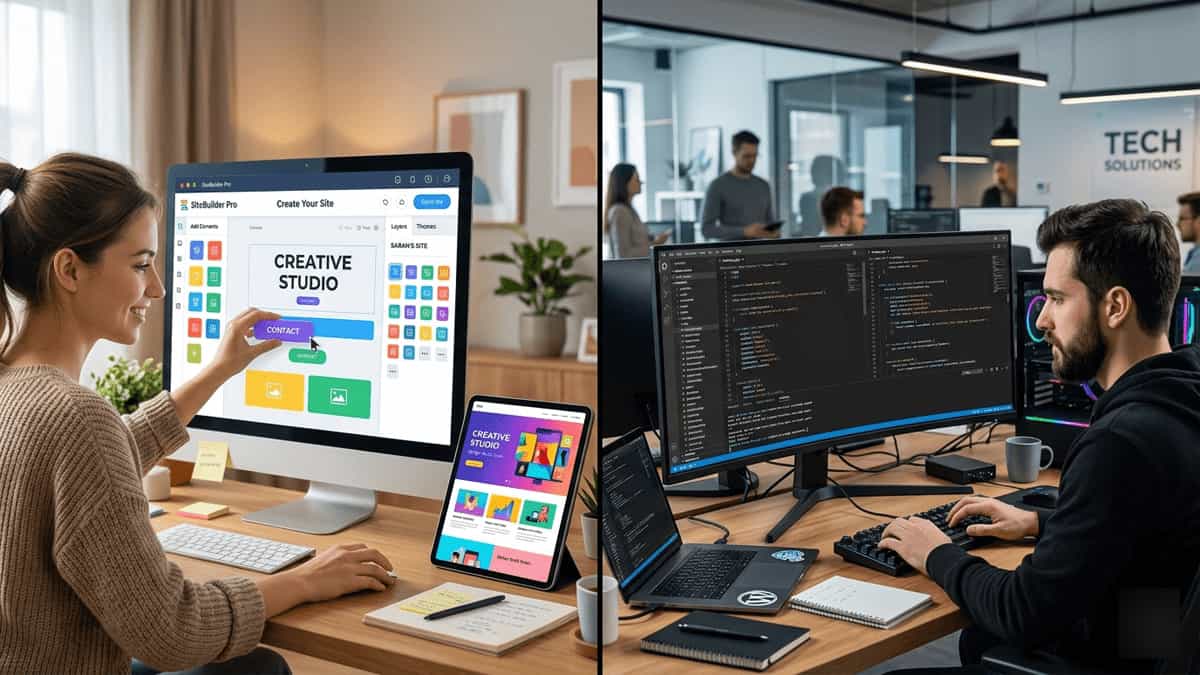
A website builder is an all‑in‑one platform that provides everything you need to create a website: a drag‑and‑drop editor, hosting, templates, and often a domain name—all under one subscription. You don’t need to buy separate hosting or install software. You simply sign up, pick a design, and start building.
Examples: Wix, Squarespace, Shopify, Weebly, GoDaddy Website Builder, Webflow (which blurs the line), and others.
Pros:
- Extremely easy to use; no technical skills required.
- Everything included (hosting, security, updates).
- Fast setup—your site can go live in a few hours.
- Support is often included.
Cons:
- Limited flexibility—you’re confined to the builder’s features and templates.
- Harder to migrate away; you don’t own the underlying code.
- Can become expensive as you add premium features.
- SEO control is often less granular than self‑hosted solutions.
What Is WordPress Hosting?
WordPress hosting refers to a hosting service specifically optimized for the open‑source WordPress content management system (CMS). You download WordPress from WordPress.org, install it on your hosting account, and then you own everything: the files, the database, and the ability to add any plugin, theme, or custom code.
Examples: Kinsta, WP Engine, SiteGround, Bluehost (WordPress plans), Cloudways, Pressable, Flywheel.
Pros:
- Complete control—you own your site and can do anything.
- Unlimited customization via plugins and themes.
- You can migrate your site to any host at any time.
- Typically better for SEO and long‑term scalability.
Cons:
- Steeper learning curve; you need to manage updates, backups, and security.
- You must purchase hosting separately (though many hosts include one‑click installs).
- You are responsible for performance optimization.
Key Differences: Website Builder vs. Self‑Hosted WordPress
Ease of use: Website builders win out of the box. WordPress can be beginner‑friendly with managed hosts, but there’s still more to learn.
Cost: Both have low‑cost entry points. Hostinger, Namecheap, and GoDaddy offer budget plans for builders and WordPress alike. But with WordPress, you can often get more for your money if you’re willing to handle a few technical details yourself.
Ownership: WordPress gives you full ownership. With a builder, you rent a space in their ecosystem.
Customization: WordPress is limitless. Builders restrict you to their app stores and templates.
Scalability: WordPress scales from a personal blog to a multinational e‑commerce empire. Builders often hit hard limits (e.g., product counts, API calls, traffic caps).
SEO: WordPress, with plugins like Yoast or Rank Math, offers advanced control. Builders have improved, but power users still prefer WordPress.
Security & updates: Builders handle everything. With WordPress, you’re either responsible (on cheap shared hosts) or your managed host takes care of it (Kinsta, WP Engine, etc.).
Migration: WordPress sites can be moved freely between hosts. Builder sites are largely trapped—leaving requires rebuilding.
Top Website Builders (All‑in‑One Platforms)
| Provider | Best For | Starting Price | Key Strengths | Limitations |
|---|---|---|---|---|
| Wix | Beginners, small businesses, creatives | $10/month | Massive template selection, intuitive drag‑and‑drop, extensive app market | Template lock‑in; cannot switch templates once live without rebuilding |
| Squarespace | Creatives, portfolios, small shops | $16/month | Beautiful design‑first templates, built‑in e‑commerce, all‑in‑one simplicity | Less flexible for complex functionality; fewer third‑party integrations |
| Shopify | E‑commerce of any size | $29/month | Best‑in‑class e‑commerce features, payment gateways, POS, huge app ecosystem | Transaction fees unless using Shopify Payments; blogging is basic |
| Weebly (Square) | Small businesses, simple sites | $6/month | Very easy to use, good for simple sites, Square integration | Limited design flexibility; fewer features than Wix/Squarespace |
| GoDaddy Website Builder | Quick, simple business sites | $6.99/month | AI‑assisted setup, fast, bundled with domain/email | Very basic; limited customization |
| Webflow | Designers, advanced visual builders | $14/month | Design freedom with visual coding; exportable code | Steeper learning curve; more technical than other builders |
| BigCommerce | E‑commerce scaling | $29/month | Strong built‑in features for large catalogs; no transaction fees | Less beginner‑friendly than Shopify; fewer templates |
| Hostinger Website Builder | Budget‑conscious beginners | $2.99/month | Very low price, AI‑assisted, includes hosting and domain | Simpler feature set; less design flexibility than Wix |
| Namecheap Website Builder | Budget small business sites | $3.88/month | Affordable, simple drag‑and‑drop, includes domain and SSL | Basic functionality; not suited for complex sites or e‑commerce |
Top WordPress Hosting Providers
| Provider | Best For | Starting Price | Key Strengths | Limitations |
|---|---|---|---|---|
| Kinsta | High‑performance sites, businesses | $35/month | Google Cloud Platform, automatic daily backups, stellar support, staging | Higher price point |
| WP Engine | Managed WordPress for businesses | $20/month | Proprietary EverCache, great security, developer tools | Strict plugin restrictions on lower plans |
| SiteGround | Budget‑friendly managed WordPress | $2.99/month (intro) | Excellent support, built‑in caching, free CDN | Renewal rates are higher |
| Bluehost | Beginners, budget sites | $2.95/month | Officially recommended by WordPress.org, easy setup, free domain for first year | Performance can be inconsistent on shared plans |
| Cloudways | Developers, flexible hosting | $11/month | Pay‑as‑you‑go cloud (DigitalOcean, AWS, etc.), full server control | No email hosting; requires some server knowledge |
| Pressable (Automattic) | High‑traffic WordPress sites | $25/month | Built by WordPress experts, scalable, great for agencies | Limited storage on lower plans |
| Flywheel (WP Engine) | Designers, agencies | $13/month | Beautiful dashboard, managed updates, billing by site | Pricing tiers based on visits |
| Hostinger | Budget shared WordPress | $2.99/month | Very low cost, custom hPanel, free domain and SSL | Shared environment; support may be slower |
| GoDaddy Managed WordPress | Beginners, all‑in‑one convenience | $6.99/month | Easy setup, domain bundled, 24/7 support | Performance varies; upsells common |
| Namecheap EasyWP | Simple WordPress starter | $3.88/month | Affordable, pre‑configured WordPress, fast SSD storage | Limited to 50k visitors on starter plan; no phone support |
Why These Providers Belong in the Comparison
- Hostinger: One of the most affordable players, with a strong presence in the budget WordPress hosting space and a surprisingly capable website builder. It’s often the first stop for beginners with a tight budget.
- GoDaddy: The world’s largest domain registrar; many users start here because they already have their domain. Their website builder and managed WordPress plans are widely used, even if not the performance leaders.
- Namecheap: A trusted domain registrar with a growing hosting arm. Their EasyWP product is a streamlined, low‑cost entry point for WordPress, and their website builder offers a no‑frills option for simple business sites.
Real‑World Scenarios: Which Path Fits Your Project?
Scenario 1: A Freelance Photographer’s Portfolio
- Needs: Beautiful image gallery, contact form, quick setup, low maintenance.
- Best fit: Squarespace or Wix. Their templates are design‑focused and require no hosting management.
Scenario 2: A Small Bakery with Online Ordering
- Needs: Easy‑to‑update menu, simple e‑commerce, local pickup.
- Best fit: WordPress + WooCommerce (with managed hosting) if you want full control, or Squarespace / Wix if you prefer simplicity. Shopify might be overkill.
Scenario 3: A SaaS Company Targeting Global Scale
- Needs: Custom landing pages, blog, API integrations, A/B testing, high performance.
- Best fit: Self‑hosted WordPress on a premium managed host like Kinsta or WP Engine. You’ll need the flexibility to add custom code and scale traffic.
Scenario 4: A Blogger Aspiring to Grow into a Media Brand
- Needs: SEO control, fast loading, monetization (ads, affiliate), custom design.
- Best fit: WordPress (self‑hosted) . No website builder gives you the same level of SEO plugins, ad management, and content organization.
Scenario 5: A Non‑Profit with Volunteer Content Editors
- Needs: Easy editing for non‑technical staff, donation forms, event calendar.
- Best fit: WordPress with a page builder like Elementor. It balances ease of use with the ability to add donation plugins (GiveWP) and custom post types.
Frequently Asked Questions
Q1: Can I migrate from a website builder to WordPress later?
Yes, but it’s not automatic. You can export content from some builders (like Squarespace) to WordPress using plugins or manual copy‑paste. Design and functionality will need to be rebuilt. This is a major reason to start with WordPress if you anticipate growth.
Q2: Is WordPress really free?
WordPress itself is free open‑source software. You pay for hosting, a domain name, and optionally premium themes/plugins. So while the software is free, running a WordPress site has costs.
Q3: Which is better for SEO: website builder or WordPress?
WordPress offers more advanced SEO tools (e.g., Yoast, Rank Math) and total control over technical SEO elements (structured data, schema, speed optimization). Website builders have improved their SEO features, but advanced users will still prefer WordPress.
Q4: What about security? Do I need to worry about hacks with WordPress?
With a managed WordPress host, security is largely handled for you. If you use a cheap shared host, you must keep WordPress, plugins, and themes updated. Website builders handle security entirely, which is a plus for beginners.
Q5: Can I use both? For example, use a website builder for a landing page and WordPress for my blog?
You can, but it’s usually better to keep everything on one platform to avoid managing multiple systems. Subdomains like blog.yoursite.com can be WordPress while the main site is a builder, but this adds complexity.
Q6: How do I choose between managed WordPress hosting and a budget shared host?
- Budget shared host (Bluehost, GoDaddy): Fine for very small sites, but performance and support may degrade as traffic grows.
- Managed WordPress host (Kinsta, WP Engine): Worth the extra cost if you value speed, security, and scalability. They often include staging environments, automatic backups, and expert support.
Final Wrap
The choice between a website builder and WordPress hosting is ultimately about trade‑offs: ease of use versus control, simplicity versus scalability, and speed of launch versus long‑term flexibility.
- Choose a website builder if you want the quickest, easiest path to a professional‑looking site and you don’t anticipate needing advanced features or custom development.
- Choose self‑hosted WordPress if you want full ownership, unlimited customization, and the ability to grow your site without platform‑imposed limits.
For most people planning to build a serious online presence—a business, a growing blog, or an e‑commerce store—WordPress with quality managed hosting is the long‑term winner. It gives you the freedom to start small and expand into a powerful digital asset.
If you’ve already decided on WordPress, securing your site with the right SSL certificate and understanding website security beyond SSL are essential next steps. Explore our guides:
- DV SSL vs. Wildcard SSL: Which One Do You Need?
- Website Security vs. SSL Security: Why the Padlock Isn’t Enough
And if you’re still hunting for the perfect domain name before you start building, check out Perfect Domain Name Taken? Smart Founder’s Tips .
Your website is your digital headquarters. Choosing the right foundation now will save you headaches later. Whether you pick the simplicity of a website builder or the power of WordPress, make sure it aligns with your vision—and your future growth.