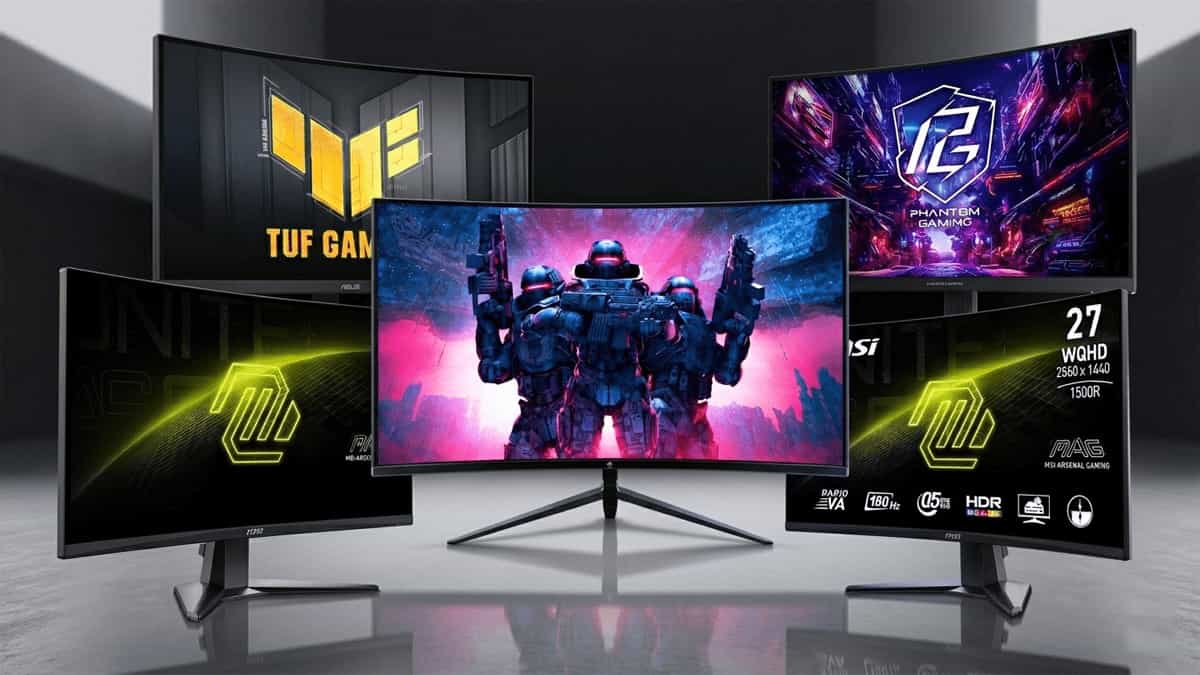

You’re looking at Samsung’s Odyssey lineup, and two names keep coming up: the Odyssey G7 and the Odyssey G9. Both are curved, both boast 240Hz refresh rates, and both promise an immersive gaming experience. But they are not the same monitor.
One is a traditional 16:9 QHD display available in 27″ and 32″ sizes. The other is a jaw‑dropping 49″ super ultrawide that replaces two monitors entirely. Your choice isn’t just about size – it’s about desk space, budget, and what kind of immersion you actually want.
Let’s break down the real differences between these two legendary monitors so you can pick the one that actually fits your setup.
At a Glance: The Contenders
| Model | Key Strengths |
|---|---|
| Samsung Odyssey G7 | Traditional 16:9 QHD, 27″ or 32″ sizes, HDR600, more affordable, fits standard desks |
| Samsung Odyssey G9 | Massive 49″ super ultrawide (32:9), dual‑QHD resolution, HDR1000, ultimate immersion |
Both share the 1000R curvature (the most aggressive curve on the market), 240Hz refresh rate, 1ms response time, and support for both NVIDIA G‑Sync and AMD FreeSync Premium Pro . But beyond that, they cater to completely different gamers.
Full Feature Comparison Table
| Feature | Odyssey G7 | Odyssey G9 |
|---|---|---|
| Screen Size | 27″ or 32″ | 49″ |
| Aspect Ratio | 16:9 | 32:9 (super ultrawide) |
| Resolution | 2560 × 1440 (QHD) | 5120 × 1440 (dual QHD) |
| Curvature | 1000R | 1000R |
| Refresh Rate | 240Hz | 240Hz |
| Response Time | 1ms (GTG) | 1ms (GTG) |
| Panel Type | QLED VA | QLED VA |
| HDR Rating | HDR600 | HDR1000 |
| Peak Brightness | 350 cd/m² (typical) | 420 cd/m² (typical) / 1000 cd/m² peak |
| Static Contrast | 2500:1 | 2500:1 |
| Variable Sync | G‑Sync Compatible + FreeSync Premium Pro | G‑Sync Compatible + FreeSync Premium Pro |
| Ports | DP 1.4, HDMI 2.0, USB 3.0 | DP 1.4, HDMI 2.0, USB 3.0, USB‑C (on some models) |
| Back Design | Matte black with blue accents | Glossy white with Infinity Core Lighting |
| Dimensions (W×H×D) | 24.0″ × 21.2″ × 12.0″ (27″ model) | 45.2″ × 21.2″ × 16.4″ |
| Weight | ~15.9 lbs (27″) | ~31.1 lbs |
| Price (2026 market) | ~$700 (40″ 4K variant available) | OLED G9 as low as $800 on sale |
Where These Monitors Actually Differ
(This Changes Your Choice)
1. Screen Real Estate – One Monitor or Two?
The Odyssey G9 is a 49″ super ultrawide with a 32:9 aspect ratio. That’s literally two 27″ QHD monitors side‑by‑side without a bezel in the middle . It’s designed for gamers who want total immersion – racing sims, flight simulators, and open‑world games feel like they wrap around you.
The Odyssey G7 sticks to the familiar 16:9 format in 27″ or 32″ sizes. It’s a traditional monitor that fits easily on most desks and works with every game without compatibility quirks.
2. Resolution & Pixel Density
- G9: 5120 × 1440 – the same pixel density as a 27″ QHD monitor, just stretched wider.
- G7: 2560 × 1440 – sharp and clear, easier to drive with mid‑range GPUs.
If you’re running a high‑end graphics card (RTX 4070 Ti or above), the G9’s resolution is manageable. But if you’re on a mid‑range GPU, the G7’s QHD resolution will be much easier to hit high frame rates .
3. HDR & Brightness – The Premium Difference
The G9 carries an HDR1000 certification, meaning it can hit 1000 nits peak brightness for stunning highlights in HDR content. The G7 is rated HDR600, which is still good but doesn’t deliver the same punch .
If you watch a lot of HDR movies or play HDR‑optimized games, the G9 offers a noticeably better experience.
4. Desk Space & Setup
This is where the G9 demands commitment:
- Width: 45.2 inches (over 3.7 feet) – you need a very deep desk (at least 30″) to place it comfortably .
- Weight: 31 lbs – sturdy desk required.
- G7: Fits on a standard desk with room for peripherals.
5. Aesthetics – Futuristic vs. Stealth
- G9: Glossy white back, Infinity Core Lighting (the iconic circular LED), looks like a spaceship .
- G7: Matte black with subtle blue vents, still aggressive but more understated .
Don’t Overthink It — Here’s the Simple Answer
- Want the most immersive gaming experience possible? → Odyssey G9 (if your desk and GPU can handle it)
- Want a traditional high‑end gaming monitor that fits any setup? → Odyssey G7 (27″ or 32″)
- On a budget but still want premium features? → Look for the G7 27″ or watch for G9 OLED sales (recently dropped to $800)
Which One Should You Choose?
Pick the Samsung Odyssey G7 if …
- You have a standard desk and don’t want to rearrange your entire setup.
- You’re running a mid‑range GPU (RTX 3060–4070) and want high frame rates at QHD.
- You prefer a 16:9 aspect ratio for compatibility with all games and media.
- You want premium gaming features (240Hz, G‑Sync, 1000R curve) without the $1,500+ price tag.
Pick the Samsung Odyssey G9 if …
- You want the most immersive gaming experience – sim racing, flight sims, or open‑world games.
- You have a high‑end GPU (RTX 4080/4090 or equivalent) to drive 5120×1440 at high refresh rates.
- You have a deep desk (at least 30″) or a dedicated monitor mount.
- You’re ready to spend more for HDR1000 and the ultimate multitasking workspace (two monitors in one).
Final Thoughts
The Odyssey G7 and G9 share the same DNA – 1000R curvature, 240Hz, 1ms response, and premium sync technologies – but they serve different masters.
The G7 is the practical choice. It delivers all the high‑end gaming features in a traditional 16:9 format that fits any desk and any GPU budget. It’s the safer bet for most gamers.
The G9 is the statement piece. It’s for enthusiasts who want the widest possible field of view, HDR1000 brightness, and a monitor that turns heads. But it demands desk space, GPU power, and a bigger budget.
If you have the space and the GPU, the G9 is an unforgettable experience. If you want the same core features in a more manageable package, the G7 is your winner.
More PC & Gaming Resources
This article was originally published on Mukunda Software. Specifications based on manufacturer data and current market pricing as of March 2026.