
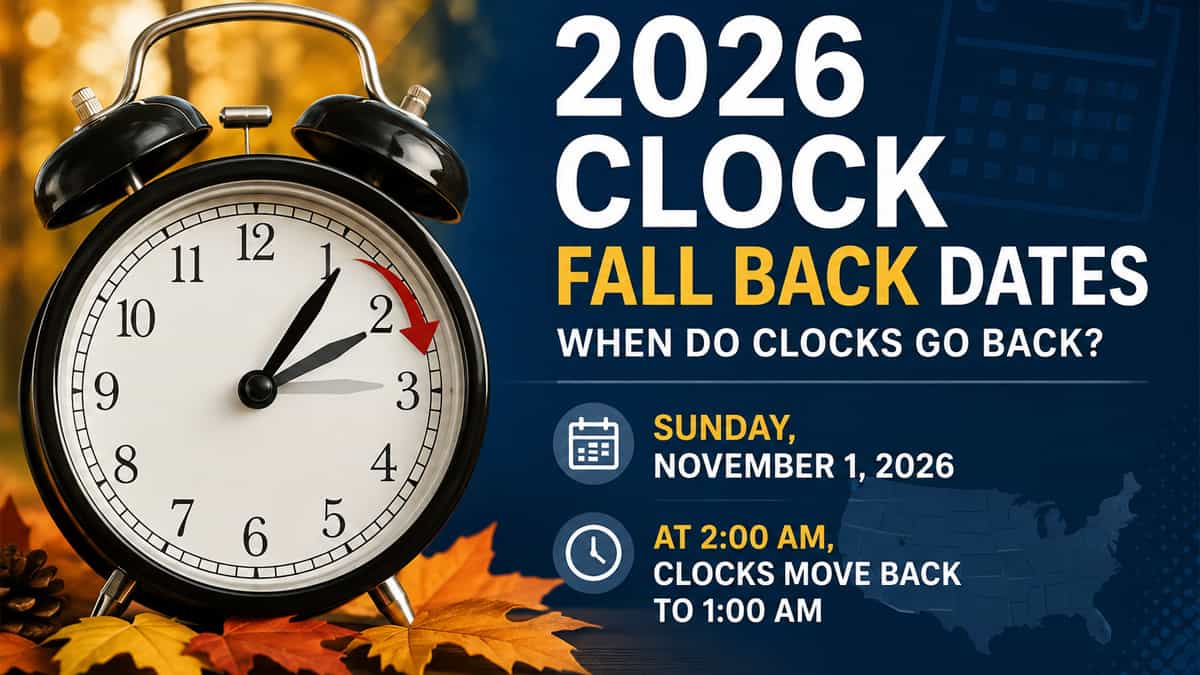
The 2026 clock fall back date in the United States is Sunday, November 1, 2026.
In most parts of the U.S. that observe Daylight Saving Time (DST), clocks will move back one hour from 2:00 a.m. to 1:00 a.m. when Daylight Saving Time ends.
The change gives the overnight period an extra hour and returns affected locations to standard time.
Under the current U.S. schedule, Daylight Saving Time ends on the first Sunday of November, making November 1 the earliest possible fall-back date in 2026.
2026 Clock Fall Back Date at a Glance
| Detail | 2026 Date or Time |
|---|---|
| U.S. Fall Back Date | Sunday, November 1, 2026 |
| Clock Change | 2:00 a.m. → 1:00 a.m. |
| Change | Back 1 hour |
| DST Ends | November 1, 2026 |
| Time After Change | Standard Time |
| Next U.S. DST Start | March 14, 2027 |
| Next U.S. Fall Back | November 7, 2027 |
The National Institute of Standards and Technology (NIST) confirms that U.S. Daylight Saving Time in 2026 ends on November 1 at 2:00 a.m. local time. NIST Daylight Saving Time information
When Do Clocks Fall Back in 2026?
In most of the United States, clocks will fall back on Sunday, November 1, 2026.
At 2:00 a.m. local daylight time, clocks move backward to 1:00 a.m. standard time.
This means the hour between 1:00 a.m. and 2:00 a.m. occurs twice.
That repeated hour is why people often describe the fall-back transition as gaining an extra hour.
What Time Do Clocks Go Back in 2026?
The U.S. fall-back transition occurs at:
2:00 a.m. → 1:00 a.m.
The clock moves backward by one hour, and the affected location returns from Daylight Saving Time to standard time.
The change occurs according to local time in each U.S. time zone that observes DST.
Why Is November 1 the Earliest Possible Fall Back Date?
The current U.S. rule requires Daylight Saving Time to end on the first Sunday in November.
In 2026, November 1 falls on a Sunday.
Therefore, November 1 is the earliest possible date for the U.S. fall-back transition under the current rule.
The 2026 U.S. DST period begins on March 8 and ends on November 1. NIST Daylight Saving Time information
What Happens When the Clocks Fall Back?
When local daylight time reaches 2:00 a.m., the clock moves backward to 1:00 a.m. standard time.
The result is a repeated hour:
1:00 a.m. → 2:00 a.m.
Then:
2:00 a.m. → 1:00 a.m.
The 1:00 a.m. to 2:00 a.m. period therefore happens twice.
The practical effects include:
- An extra hour during the overnight period
- Earlier sunrise by the clock
- Earlier sunset by the clock
- The end of Daylight Saving Time
- A return to standard time
The exact sunrise and sunset times depend on the location.
Do All U.S. States Fall Back in 2026?
No.
Most U.S. states observe Daylight Saving Time, but some areas do not change their clocks.
Hawaii
Hawaii does not observe Daylight Saving Time.
Its clocks remain on Hawaii-Aleutian Standard Time throughout the year.
Arizona
Most of Arizona does not observe Daylight Saving Time.
However, the Navajo Nation observes DST, so the rules are not identical throughout the state.
U.S. Territories
Several U.S. territories also do not observe Daylight Saving Time.
Because of these exceptions, November 1, 2026, should not be treated as a clock-change date for every U.S. location.
2026 Fall Back Dates by U.S. Time Zone
For locations observing Daylight Saving Time, the fall-back transition occurs at 2:00 a.m. local daylight time.
| U.S. Time Zone | Clock Change | Standard Time After Fall Back |
|---|---|---|
| Eastern Time | 2:00 a.m. → 1:00 a.m. | EST |
| Central Time | 2:00 a.m. → 1:00 a.m. | CST |
| Mountain Time | 2:00 a.m. → 1:00 a.m. | MST |
| Pacific Time | 2:00 a.m. → 1:00 a.m. | PST |
| Alaska Time | 2:00 a.m. → 1:00 a.m. | AKST |
The exact application of DST depends on whether the specific location observes the seasonal clock change.
When Does Daylight Saving Time End in 2026?
For most U.S. locations that observe DST, Daylight Saving Time ends on Sunday, November 1, 2026.
At 2:00 a.m., clocks move back one hour to 1:00 a.m.
The official U.S. schedule establishes the end of DST on the first Sunday in November. NIST Daylight Saving Time information
Is November 1, 2026 a Sunday?
Yes.
November 1, 2026, is Sunday, which makes it the first Sunday of November.
That is why the 2026 fall-back date lands on November 1.
It is also the earliest calendar date on which the U.S. fall-back transition can occur under the current first-Sunday-of-November rule.
Do You Get an Extra Hour When the Clocks Fall Back?
The clock repeats one hour, so the overnight period contains an extra hour.
For example, after the clock reaches 2:00 a.m., it moves back to 1:00 a.m.
This means the 1:00 a.m. hour occurs twice.
Whether you actually get an extra hour of sleep depends on your schedule.
What Happens to Sunrise and Sunset After Fall Back?
The clock change does not create or remove daylight.
Instead, it changes how daylight is represented on the clock.
After the fall-back transition:
- Sunrise occurs at an earlier clock time.
- Sunset occurs at an earlier clock time.
- Morning daylight arrives earlier according to the clock.
- Evening darkness arrives earlier according to the clock.
The exact change varies by location and date.
Do Phones Automatically Change Their Clocks?
Usually, yes.
Modern smartphones can automatically adjust their clocks when automatic time and time-zone settings are enabled.
The same is generally true for modern computers and other connected devices.
However, automatic changes depend on the device having:
- The correct time zone
- Automatic date and time enabled
- Updated time-zone information
- A functioning network or time-synchronization service where required
Older devices may still require manual adjustment.
Which Devices Should You Check?
Although smartphones and computers usually update automatically, some clocks may not.
It can be worth checking:
- Wall clocks
- Alarm clocks
- Watches
- Car clocks
- Kitchen appliances
- Digital displays
- Older computers
- Security systems
- Industrial equipment
- Manually configured devices
If a device does not automatically recognize the U.S. DST transition, its displayed time may be wrong after November 1.
Why Does Fall Back Matter for Software?
The U.S. clock change can affect software systems that work with local dates and times.
This is especially important for applications that schedule events or perform actions at specific local times.
Examples include:
- Scheduled tasks
- Calendar events
- Online meetings
- Notifications
- Recurring jobs
- Appointment systems
- E-commerce orders
- Database timestamps
- Server logs
- Automated reports
- Time-based APIs
A recurring event scheduled for a particular local time can encounter a duplicated hour during the fall-back transition.
For software developers, this is one reason time zones should not be treated as simple fixed UTC offsets.
Applications need to account for the applicable U.S. time-zone and Daylight Saving Time rules.
What Happens to Online Meetings During Fall Back?
The fall-back transition can affect recurring meetings and scheduled events.
For example, a meeting scheduled between people in different U.S. time zones may appear at different local clock times even though the actual moment is the same.
Calendar applications that correctly use time zones generally handle these conversions automatically.
Still, important meetings scheduled around November 1 should be checked, particularly when working across multiple U.S. time zones.
Fall Back vs. Spring Forward
The two U.S. seasonal clock changes work in opposite directions.
| Clock Change | What Happens |
|---|---|
| Spring Forward | Clocks move ahead 1 hour |
| Fall Back | Clocks move back 1 hour |
| 2026 U.S. Spring Forward | March 8, 2026 |
| 2026 U.S. Fall Back | November 1, 2026 |
| 2027 U.S. Spring Forward | March 14, 2027 |
| 2027 U.S. Fall Back | November 7, 2027 |
Under the current U.S. schedule, the next spring-forward transition after November 1, 2026, is March 14, 2027, followed by the next fall-back transition on November 7, 2027.
What Is the Difference Between Daylight Time and Standard Time?
During the U.S. Daylight Saving Time period, participating locations use their daylight-time designation.
When the clocks fall back, those locations return to their standard-time designation.
For example:
- Eastern Daylight Time → Eastern Standard Time
- Central Daylight Time → Central Standard Time
- Mountain Daylight Time → Mountain Standard Time
- Pacific Daylight Time → Pacific Standard Time
The UTC offset therefore changes when the clock moves back.
Why Do Some U.S. Areas Not Observe Daylight Saving Time?
Daylight Saving Time is not mandatory for every U.S. state or territory.
Federal law establishes the framework for the seasonal change, while states and territories can choose whether to observe it within the applicable legal framework.
This is why Hawaii and most of Arizona remain on their respective standard schedules instead of changing clocks twice each year.
2026 Clock Fall Back: Quick Answers
When do clocks fall back in 2026?
In most of the United States, clocks fall back on Sunday, November 1, 2026.
What time do clocks go back?
At 2:00 a.m., clocks move back to 1:00 a.m. in U.S. locations observing Daylight Saving Time.
Do clocks go back one hour?
Yes. The clock moves back exactly one hour.
Do we gain an hour?
The clock repeats the 1:00 a.m. to 2:00 a.m. period, creating an extra hour in the overnight schedule.
Is November 1 the earliest possible fall-back date?
Yes. Under the current U.S. rule, Daylight Saving Time ends on the first Sunday of November. November 1 is the earliest possible date.
Do all states change their clocks?
No. Hawaii and most of Arizona do not observe Daylight Saving Time. There are also U.S. territories that do not observe it.
Will my phone change automatically?
Most modern phones will automatically update when automatic date, time and time-zone settings are enabled.
What is the next clock change after November 1, 2026?
The next scheduled U.S. spring-forward date is March 14, 2027.
When is the next U.S. fall-back date?
Under the current schedule, the next U.S. fall-back date is November 7, 2027.
Final Takeaway
The 2026 clock fall back date in most of the United States is Sunday, November 1, 2026.
At 2:00 a.m., clocks move back to 1:00 a.m., ending Daylight Saving Time and returning participating locations to standard time.
November 1 is the earliest possible first-Sunday-of-November fall-back date under the current U.S. schedule.
Most smartphones and computers will handle the change automatically when their time and time-zone settings are configured correctly, but manually operated clocks and older devices may need to be adjusted.
For most U.S. locations, the date to remember is:
Fall Back 2026 = Sunday, November 1, 2026 → 2:00 a.m. becomes 1:00 a.m.