
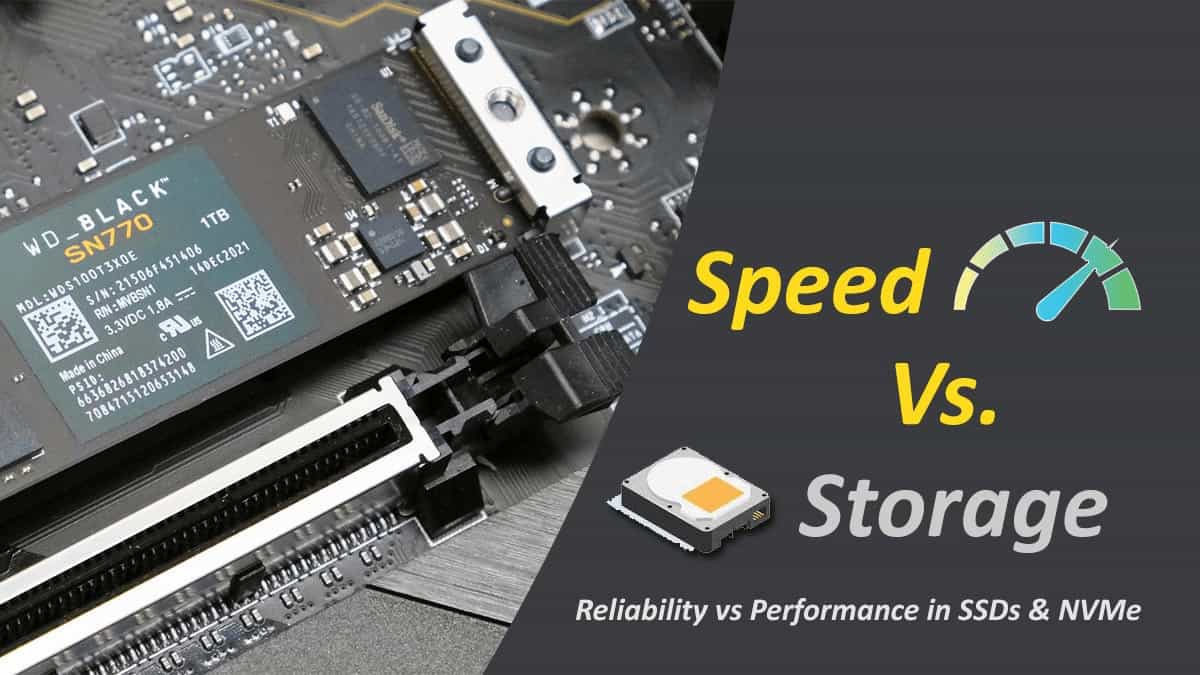
Most users buy SSDs and NVMe drives based on benchmarks — but in real-world systems, storage reliability depends on endurance, temperature, NAND quality, controller design, and workload patterns — not raw megabytes per second.
This guide explains:
- TBW & NAND endurance
- TLC vs QLC vs 3D NAND
- why DRAM cache matters
- NVMe heat & throttling risks
- CMR vs SMR HDD reliability
- sudden vs gradual failure behavior
- developer workload impact
- enterprise-grade storage strategy
Not marketing.
Not hype.
Pure engineering reality.
📖 Key Terms at a Glance
| Term | Full Form | Simple Meaning |
| SSD | Solid State Drive | Fast flash-based storage (no moving parts) |
| HDD | Hard Disk Drive | Traditional mechanical spinning drive |
| SATA | Serial ATA | Common, older storage connector |
| PCIe | PCI Express | High-speed bus used by NVMe drives |
| NVMe | Non-Volatile Memory Express | The ultra-fast protocol for modern SSDs |
| NAND | NAND Flash Memory (NAND (Negative-AND) | The physical chips where data “lives” |
| DRAM | Dynamic RAM | A high-speed helper that extends SSD life |
| TBW | Total Bytes Written | The physical “mileage” limit of your drive |
| CMR | Conventional Magnetic Recording | Reliable, high-performance HDD tech |
| SMR | Shingled Magnetic Recording | Slower HDD tech; best for “cold” storage |
| IOPS | I/O Operations Per Second | A measure of real-world “snappiness” |
| HMB | Host Memory Buffer | A budget alternative to physical DRAM |
🧠 What is TBW? (Total Bytes Written)
TBW defines how much data can be written to an SSD before its NAND cells reach their endurance threshold.
Typical TBW values:
- 500GB SSD → ~300 TBW
- 1TB SSD → ~600 TBW
Once TBW is consumed:
✔ the SSD does not slowly weaken
⚠ instead failure risk accelerates sharply
Most real-world SSD failures look like:
- yesterday → perfectly fine
- today → drive missing / no boot / unreadable
Users think:
“My SSD died suddenly.”
Reality:
👉 its write-cycle life completed
⚠ High-end SSD controllers behave differently
Enterprise & prosumer SSDs often:
✔ throttle write performance
✔ enter read-only protection mode
✔ give a last backup window
Cheap SSDs usually:
❌ fail with no warning
❌ no read-only mode
❌ instant controller death
That’s why endurance matters more than speed.
🔬 NAND Types — The Real Driver of SSD Lifespan
NAND = flash memory where data is stored.
Different NAND grades = different endurance.
✔ TLC NAND (best balance for workstations)
- higher write endurance
- better wear-leveling
- predictable aging
Recommended for:
✔ OS
✔ dev workloads
✔ build machines
✔ long-session systems
⚠ QLC NAND (budget SSDs)
- fewer write cycles
- collapses after cache exhaustion
- weak under sustained workloads
Okay for: 🟡 light consumer storage
Avoid for:
❌ OS
❌ development
❌ logging / scraping
❌ database workloads
🟢 3D NAND
Layered cell structure improves:
✔ density
✔ efficiency
✔ lifespan
Now standard in most modern TLC SSDs.
🧩 Why is it Called “NAND” Flash? (Negative-AND)
Most people assume NAND is just a brand name or a random technical acronym NAND is just a storage term. In reality, the name comes from digital logic gates, the fundamental building blocks of electronics.
The Logic Gate Origin
In electronics, there is a basic logic gate called AND Gate.
- 1 AND 1 → 1
- any 0 in inputs → 0
Now take the inverse of AND:
NOT(AND) = NAND
also called Negative-AND
Meaning:
- 1 AND 1 → becomes 0
- any 0 in inputs → becomes 1
That inverted behavior is what gave NAND its name.
🧠 So why is Flash Memory called “NAND”?
Early flash memory arrays showed the same switching behavior pattern as NAND logic:
- charged cell = interpreted as 0
- uncharged cell = interpreted as 1
This matched the NAND logic truth-table pattern
So researchers described it as:
“NAND-type transistor flash memory array”
From there:
👉 the architecture name stuck as NAND Flash Memory
It is a behavior-inspired name, not a literal gate structure.
⚠ What NAND Flash DOES NOT mean
It does not mean:
❌ SSD contains physical NAND logic gates
❌ NAND gates are performing computation inside storage
❌ SSD works like a logic chip internally
It simply means:
✔ the storage cell array
✔ follows NAND-style switching behavior
✔ at an electrical / logic characteristic level
🧠 Why does this matter for your SSD?
Flash memory doesn’t contain a bunch of “calculating” logic gates. Instead, the name refers to how the cells are wired together:
- Serial Architecture: In an SSD, memory cells are connected in series (daisy-chained).
- The Behavior: This specific wiring pattern means the string only “activates” (conducts current) in a way that matches the NAND logic truth table.
- The Result: Because the electrical behavior mirrored the gate, researchers in the 1980s began calling it “NAND-type Flash.”
🟢 NAND vs. NOR Flash (Why SSDs Won)
There is another type of flash called NOR Flash (NOT-OR logic). While NOR was invented first, NAND became the king of storage for three reasons:
| Feature | NOR Flash | NAND Flash (Your SSD) |
| Wiring | Parallel | Serial (Series) |
| Density | Low (Takes more space) | High (Very compact) |
| Strength | Fast random reads | Fast sequential writes |
| Use Case | BIOS / Firmware | SSDs, Phones, SD Cards |
🧮 What actually determines SSD lifespan?
SSD life depends on:
✔ NAND type
✔ TBW endurance
✔ controller quality
✔ wear-leveling
✔ drive temperature
✔ workload intensity
NOT on interface type.
❌ SATA vs NVMe ≠ durability
✔ both fail for the same reasons
NVMe just fails faster & more suddenly when overheated or stressed.
🚀 SSD vs NVMe — What Really Changes?
People assume:
NVMe = faster = better
Speed ≠ reliability.
Lifespan depends on:
✔ NAND endurance
✔ TBW
✔ thermal behavior
✔ controller + DRAM cache
✔ workload pattern
A good TLC SATA SSD can outlast
a cheap QLC NVMe any day.
🔥 NVMe’s Biggest Enemy = HEAT
NVMe drives often sit:
- under GPUs
- beside VRM heat zones
- in low-airflow areas
If temps sustain:
🔥 70–80°C or higher
Then:
❌ thermal throttling
❌ controller stress
❌ write amplification
❌ NAND degradation accelerates
Heatsinks are not cosmetic.
👉 they are a lifespan requirement, especially for:
- compilers
- build pipelines
- containers
- log-heavy environments
Cooler SSD = longer life.
🧩 DRAM Cache — The Silent Protector of SSD Endurance
DRAM cache handles:
✔ mapping table storage
✔ smoother sustained writes
✔ lower write amplification
✔ better wear-distribution
DRAM-less SSDs:
❌ stutter under load
❌ degrade faster
❌ random UI freezes
❌ unpredictable failure curves
Host Memory Buffer (HMB) helps —
but dedicated DRAM is still superior.
🧱 CMR vs SMR HDD — Critical for Developers
🟢 CMR HDD (Conventional Magnetic Recording)
✔ predictable performance
✔ safe for sustained writes
✔ consistent archival behavior
Best for:
- local project archives
- build snapshots
- offline backups
- long-term retention
⚠ SMR HDD (Shingled Magnetic Recording)
Tracks overlap like roof tiles.
Causes:
❌ write stalls
❌ copy freeze
❌ I/O lockups under logs / builds
Good ONLY for:
🟡 cold storage
Avoid for:
❌ OS
❌ dev workloads
❌ database logs
❌ backup targets
🏆 Real-World Durability Ranking (Longest → Shortest)
1️⃣ Enterprise / Datacenter SSD (TLC + DRAM)
2️⃣ High-end TLC NVMe (heatsink + DRAM)
3️⃣ Good TLC SATA SSD (MX500 / 870 EVO class)
4️⃣ Budget TLC NVMe
5️⃣ QLC NVMe
6️⃣ DRAM-less SSD (shortest practical life)
Ranked by endurance, not benchmark speed.
🏆 The Storage Reliability Formulas
✔ Context-based — not one-size-fits-all
Different workloads need different reliability models.
This is the truth nobody explains.
🟢 Performance-First Workstation (Modern Standard)
Best for:
✔ UI-heavy workflows
✔ multitasking
✔ frequent reboot environments
Recommended layout
| Layer | Storage Type |
|---|---|
| OS & Apps | TLC NVMe (DRAM + Heatsink) |
| Active Projects | TLC SATA SSD |
| Archive / Backups | CMR HDD / NAS / Cloud |
Delivers:
⚡ responsive system
🧠 future-proof performance
🟣 Reliability-First Workstation (Enterprise Stability Model)
Best for:
✔ dev environments
✔ build pipelines
✔ long-session workloads
✔ systems where failure behaviour matters
Recommended layout
| Role | Storage Type |
|---|---|
| Primary OS & Work Drive | Enterprise TLC SSD / NVMe (DRAM + Heatsink) |
| Local Archive / Snapshots | CMR HDD |
| Cold Offline Backup | External HDD / NAS / remote snapshot |
Why this works:
✔ higher TBW endurance
✔ better wear-leveling
✔ many enterprise SSDs enter read-only safe mode at end-of-life
✔ HDD archive degrades gradually (predictable recovery path)
This pairing =
tank-level durability + workstation speed.
🧾 Proven Long-Life SSD Families (Reference Table)
🟢 Enterprise / Datacenter SSDs
| Model | Type | Endurance Class |
|---|---|---|
| Samsung PM9A3 / PM983 | TLC NVMe | Multi-PBW |
| Intel DC / P4510 | TLC NVMe | Datacenter |
| Micron 7400 / 7450 | TLC NVMe | Enterprise |
| WD Ultrastar NVMe | TLC NVMe | High-endurance |
Built for:
✔ sustained writes
✔ 24/7 workloads
✔ predictable aging
🟡 Consumer Long-Life SSDs
| Model | Type | Strength |
|---|---|---|
| Samsung 870 EVO | TLC SATA | endurance stability |
| Crucial MX500 | TLC SATA | consistency |
| WD Blue (TLC variants) | TLC SATA | balanced reliability |
Great for:
✔ workstations
✔ project storage
✔ long-term consumer use
🛡 Safe Settings for Aging SSDs (Archive Role)
For SSDs near TBW limit:
Keep:
✔ TRIM = ON
✔ Scheduled TRIM = ON
✔ Write-cache = OFF
✔ Buffer flushing = OFF
Use ONLY for:
✔ read-mostly storage
✔ archive files
✔ secondary tasks
Avoid:
❌ OS
❌ temp folders
❌ pagefile
❌ browser cache
❌ torrents / scraping / logging
Because worn SSDs often:
⚠ become unreadable suddenly
HDDs fail gradually — SSDs often don’t.
🟡 When NOT to Use Cache-Off Mode
If SSD becomes OS drive again:
👉 enable cache
👉 enable flushing
Operating systems require:
⚡ burst I/O
⚡ low latency
Archive mode ≠ performance mode.
❄ Why HDDs Still Matter (But Only in the Right Role)
HDDs typically:
✔ fail gradually
✔ show SMART warnings
✔ allow proactive backup
SSDs:
⚠ fail electronically
⚠ sometimes enter read-only mode
⚠ sometimes disappear instantly
The safest stack is:
👉 Enterprise TLC SSD = primary work drive
👉 CMR HDD = archive safety layer
Predictable + recoverable.
❓ FAQs — SSD Lifespan, TBW & NVMe Reliability
Does higher SSD speed mean longer life?
No — lifespan depends on NAND endurance, TBW, temperature, and workload.
Why do SSDs fail suddenly?
They hit write-cycle limits and controller enters protection mode (sometimes read-only).
Is NVMe more durable than SATA SSD?
Not inherently. Both depend on NAND quality — NVMe only improves latency & speed.
Is SMR HDD bad?
No — but it is for cold storage only, not active workloads.
Which SSD type lasts the longest?
Enterprise-grade TLC SSDs with DRAM cache & high PBW endurance.
🎯 Final Takeaway
Speed matters when:
- UI responsiveness is critical
- workloads are interactive
- systems reboot frequently
Reliability matters when:
- uptime matters more than speed
- workloads run for long sessions
- predictable failure behaviour is required
Choose storage based on:
👉 how your system works — not just how it benchmarks.